
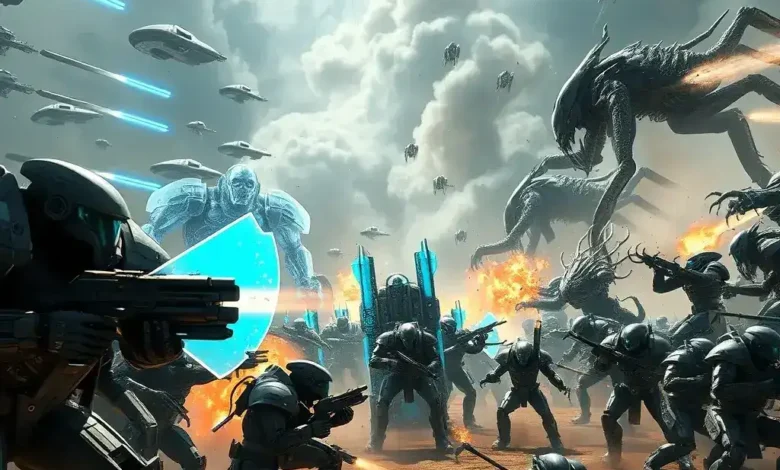
The real-time strategy genre has seen many champions rise and fall over the decades, but few have maintained their dominance as consistently as Blizzard Entertainment’s masterpiece. StarCraft II stands as a towering monument to competitive gaming, offering a depth of mechanics and balance that has kept players engaged for years. As we move into 2026, the question arises whether this legacy title still holds relevance for both veterans and newcomers. This comprehensive review analyzes every facet of the game, from its tactical depth to its technical performance on modern hardware.
🎮 Overview and Background
Released initially in 2010 and continuing its live service model for over a decade, StarCraft II represents the pinnacle of sci-fi strategy gaming. Developed by Blizzard Entertainment, the title follows the ongoing war between three distinct races: the Terrans, Zerg, and Protoss. While the base game is now free-to-play, the campaign expansions remain premium content that offers the full narrative experience. The game gained massive attention upon release due to its refined mechanics and the introduction of a robust matchmaking system that set standards for future titles.
This title targets competitive gamers who enjoy high-speed decision-making and long-term progression. Its market impact is undeniable, having established esports leagues that continue to thrive globally. For those considering entering the franchise in 2026, understanding the ecosystem is crucial. The game relies heavily on its multiplayer community, meaning a healthy player base ensures match times remain short.
- Genre: Real-Time Strategy (RTS)
- Developer: Blizzard Entertainment
- Platform: PC (Windows and macOS via Battle.net)
- Target Audience: Competitive Gamers and Strategy Enthusiasts
- Status: Free-to-Play Multiplayer / Paid Campaigns
🌍 Story Overview and Narrative Analysis
The narrative backbone of StarCraft II is split across three distinct campaigns, each focusing on a different faction. This unique approach allows players to understand the galaxy through multiple perspectives. The story begins with Wings of Liberty, following Jim Raynor, a former rebel leader seeking redemption. It transitions into Heart of the Swarm, shifting focus to Kerrigan, the Queen of Blades trying to reclaim her humanity. Finally, Legacy of the Void brings the Protoss leader Artanis to unite his people against a cosmic threat.
What makes this story stand out is the character development and the scale of the conflict. Unlike many games that rely on exposition, StarCraft II uses mission objectives and cinematic cutscenes to convey emotional weight. The writers effectively balance personal drama with galactic stakes. The ending of the trilogy provides a satisfying conclusion to the saga while leaving room for future storytelling in the broader universe.
⚔️ Core Systems and Controls
The heart of StarCraft II lies in its gameplay mechanics, which demand precision, speed, and strategic foresight. Unlike turn-based strategy games, decisions happen in real-time, requiring constant micro-management of units and macro-management of resources. The economy revolves around harvesting minerals and gas to fund an ever-growing army. Balancing these two aspects is key to success in any match.
Control responsiveness is paramount. The interface allows for rapid selection of groups and issuing of commands without lag. Players can assign hotkeys for instant access to abilities, which is essential for high-level play. The skill curve is steep, but the tutorial systems provide a solid foundation for beginners.
- Combat Mechanics: Rock-paper-scissors unit counter system ensures variety.
- AI Behavior: Single-player bots offer adaptive difficulty levels.
- Physics System: Collision detection and movement paths are optimized for fluidity.
- Control Responsiveness: Instant command execution minimizes input lag.
- Difficulty Balance: Customizable settings allow for tailored challenges.
🗺️ Map Design and Exploration Freedom
Map design in StarCraft II varies significantly depending on the game mode. In standard ladder matches, maps are symmetrical to ensure fairness, forcing players to compete based on skill rather than positional advantage. The layout includes choke points, resource nodes, and terrain features that dictate engagement strategies. Exploration freedom is limited compared to open-world titles, as the fog of war conceals enemy movements until scouts reveal them.
Mission structures in the campaign offer more linear exploration. Players unlock upgrades and research trees that persist across missions. Replay value comes from completing objectives efficiently or experimenting with different unit compositions. The Arcade mode adds infinite replayability by allowing custom scenarios created by the community.
- Map Design: Symmetrical layouts prioritize competitive integrity.
- Exploration Freedom: Fog of war creates tension and requires scouting.
- Mission Structure: Linear progression with upgrade unlocks.
- Replay Value: Arcade support extends longevity indefinitely.
🎨 Graphics and Audio Quality
Visually, StarCraft II has aged gracefully thanks to regular updates and engine refinements. The art style blends realistic textures with stylized effects that highlight the distinct nature of each race. Units are highly detailed, and spell effects are vibrant without obscuring gameplay clarity. The engine supports high-resolution displays and modern lighting technologies, making battles look spectacular even years after launch.
Audio design plays an equally critical role in immersion. Each race has unique voice lines and soundscapes that reinforce their identity. The Terrans feel industrial and mechanical, the Zerg organic and chaotic, and the Protoss ethereal and technological. Music tracks shift dynamically based on battle intensity, heightening the emotional response during climactic moments.
🖥️ Visual Quality and Engine
The game utilizes a modified version of the proprietary engine that has been supported for years. Texture quality remains sharp on modern monitors, and shadows contribute significantly to depth perception. Environmental effects like weather and day-night cycles add atmosphere to specific maps. These elements do not just serve aesthetics; they influence visibility and tactical positioning.
- Game Engine: Proprietary Blizzard Engine with continuous optimization.
- Texture Quality: High-definition assets available for all factions.
- Lighting: Dynamic shadows and ambient occlusion enhance realism.
- Shadows: Used strategically to mask unit movements.
- Environmental Effects: Weather and debris affect visual clarity.
🔊 Sound Effects and Music
The soundscape is meticulously crafted to aid communication during intense battles. Unit selection sounds confirm commands instantly, reducing cognitive load. Voice acting is performed by professional actors who capture the gravity of the situation. Whether it is a Zergling screech or a Protoss Warp Prism hum, every audio cue serves a functional purpose alongside the aesthetic one.
Immersion is further enhanced by the background music, which swells during critical encounters. This dynamic scoring system keeps players engaged without becoming repetitive. The volume mixing options allow users to adjust individual channels, ensuring critical cues are never drowned out by explosions or music.
🚀 Key Features Section
StarCraft II offers a suite of features designed to cater to different playstyles. From ranked ladder matches to cooperative co-op commanders, there is something for everyone. The inclusion of a map editor empowers the community to create endless variations of gameplay. This feature alone sustains the game long after official content releases have ceased.
The progression system rewards consistency and improvement. Players earn medals and achievements that showcase their mastery. Social features allow for clan management and team play, fostering a sense of community. Regular balance patches ensure that no single strategy dominates the meta for too long.
- Ranked Ladder: Competitive matchmaking with seasonal rewards.
- Co-op Commanders: Unique heroes with special abilities.
- Custom Games: Community-created modes and scenarios.
- Balance Patches: Frequent updates keep the game fresh.
- Esports Integration: Direct links to tournament broadcasts.
📊 Key Points Summary
| Category | Rating | Notes |
|---|---|---|
| Gameplay Depth | 10/10 | Unmatched strategic complexity |
| Graphics Quality | 8/10 | Aged well but lacks modern ray tracing |
| Community Support | 9/10 | Active modding scene and tournaments |
| Learning Curve | 7/10 | Steep for absolute beginners |
| Value for Money | 9/10 | Free multiplayer, paid campaigns |
The table above summarizes the core strengths and weaknesses of the title. Gameplay depth receives the highest score due to the intricate unit interactions and resource management required. Graphics are solid but show their age compared to newer engines. Community support remains strong, ensuring servers stay active. The learning curve is moderate to high, discouraging casual players who prefer immediate gratification. Value is exceptional given the free multiplayer access.
✅ Advantages
One of the primary reasons players return to StarCraft II is the sheer quality of its multiplayer experience. The matchmaking algorithm is generally fair, pairing opponents of similar skill levels. This reduces frustration and encourages growth. Additionally, the game runs smoothly on a wide range of hardware configurations, making it accessible to most PC gamers.
The campaign content offers hours of entertainment with high production value. Cinematics are comparable to AAA movies, providing a compelling reason to purchase the expansions. The lack of pay-to-win mechanics ensures that victory is determined solely by skill.
- Strong Performance: Optimized for low-end and high-end PCs.
- Great Gameplay: Endless strategic possibilities.
- Active Community: Large player base ensures quick lobbies.
- Regular Updates: Balance changes prevent stagnation.
❌ Disadvantages
Despite its strengths, the game is not without flaws. The entry barrier for new players is extremely high due to the complexity of controls and tactics. Beginners may feel overwhelmed by veteran opponents who execute perfect builds instantly. Furthermore, the lack of a single-player matchmaking system means campaign bots can feel predictable after extended play.
Technical issues occasionally arise, particularly when installing large patches. Server stability can fluctuate during peak tournament times. The absence of a native mobile version also limits accessibility for players on the go.
- High Skill Ceiling: Intimidating for newcomers.
- Predictable AI: Campaign bots lack advanced adaptation.
- Update Instability: Patch installation can sometimes fail.
- No Mobile Support: Restricted to desktop platforms.
💻 PERFORMANCE AND TECHNICAL ANALYSIS
Performance is a critical factor for any competitive title. StarCraft II is renowned for its optimization, running well on integrated graphics cards in some cases. However, to achieve maximum potential, specific hardware components are recommended. The game scales vertically, meaning better GPUs yield higher frame rates and smoother visuals.
🖥️ PC System Requirements
| Component | Minimum Requirement | Recommended Requirement |
|---|---|---|
| CPU | Intel Core 2 Duo E6600 or AMD Athlon X2 4400+ | Intel Core i5 or AMD Ryzen 5 |
| GPU | NVIDIA GeForce 8800 GT or ATI Radeon HD 2600 XT | NVIDIA GeForce GTX 1060 or AMD RX 580 |
| RAM | 2 GB | 8 GB |
| Storage | 30 GB available space | 50 GB SSD preferred |
Interpreting these benchmarks reveals that mid-range hardware from the last five years is sufficient for competitive play. A dedicated GPU improves visual fidelity significantly, but CPU speed is vital for processing unit calculations during large battles. Stability is generally high, though overheating can cause throttling during extended sessions. Users should ensure cooling solutions are adequate for sustained loads.
📱 Mobile Performance
It is important to note that StarCraft II does not have an official Android or iOS client. While some cloud gaming services may stream the PC version to mobile devices, native performance is not applicable. Storage size on PC averages around 50 GB including all expansions. Battery consumption is not a concern since the game is played on mains-powered devices.
- Device Compatibility: Windows and macOS only.
- Storage Size: Approximately 50 GB total.
- Battery Consumption: Not applicable (Desktop).
- Graphics Settings: Scalable from Low to Ultra.
🏁 Final Verdict and Conclusion
In conclusion, StarCraft II remains a cornerstone of the strategy genre in 2026. Its blend of deep mechanics, competitive integrity, and rich narrative makes it a timeless classic. While it demands dedication and practice, the reward for mastering the game is unparalleled satisfaction. For those willing to invest time, the journey is well worth the effort.
We recommend purchasing the campaign bundles if you wish to experience the full story, while the multiplayer portion remains free for all users. Call to action: Download the Battle.net launcher today and test your skills in the arena.
❓ Frequently Asked Questions
- Does it run on Windows 10? Yes, the game is fully optimized for Windows 10 and 11 operating systems.
- Does it support controllers? No, the game requires keyboard and mouse inputs for optimal control.
- Is internet required? Yes, an internet connection is necessary for authentication and multiplayer modes.
- Is it the full version? The base game is free, but campaigns require separate purchase.
- Can I play offline? Limited offline play is available for campaigns and versus AI.
- Is cross-platform possible? No, there is no cross-play between PC and other devices.
- Are there microtransactions? Cosmetic items exist, but they do not affect gameplay balance.
- How much storage is needed? At least 50 GB of free disk space is recommended.
- Is it suitable for beginners? It has a steep learning curve but offers tutorials.
- Does it support mods? Yes, the Arcade mode supports extensive user-created content.