
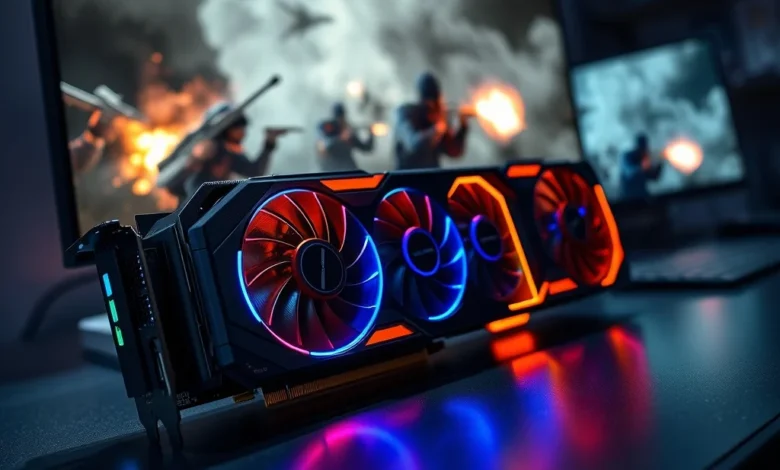
The gaming landscape for war simulations and tactical shooters has evolved dramatically by 2026. Players demanding high fidelity, realistic physics, and smooth frame rates in titles like Call of Duty, Battlefield, and Squad require hardware that can keep up with modern rendering engines. The Graphics Processing Unit, or GPU, remains the most critical component for delivering these experiences. A powerful GPU ensures that textures are crisp, lighting effects are accurate, and the action remains uninterrupted even during intense firefights. This guide delves deep into the best graphics cards available for war games in 2026, analyzing performance, value, and future-proofing capabilities.
🚀 Why GPU Performance Matters for War Games
In the realm of war games, visual fidelity is not just about aesthetics; it is about tactical advantage. Modern engines utilize complex shaders to simulate smoke, fire, and environmental destruction. A weak GPU will struggle to render these effects, leading to frame rate drops that can result in fatal lag. Furthermore, war games often feature large maps with high draw distances. This requires significant video memory to store detailed textures and models. If the GPU lacks sufficient VRAM, the game will stutter as it swaps data between the system RAM and the dedicated graphics memory. Therefore, selecting the right GPU is essential for competitive play.
Additionally, ray tracing has become a standard feature in many 2026 war game titles. This technology simulates the physical behavior of light, creating realistic reflections on metal surfaces and glass. Enabling ray tracing significantly increases the load on the GPU. Players must balance visual settings with performance needs. Understanding how different GPUs handle these workloads is crucial. We will explore the leading options from major manufacturers and how they perform in real-world scenarios.
🏆 Top GPU Picks for 2026 War Games
Identifying the best graphics card involves looking at benchmarks across popular genres. The following table summarizes the performance of top contenders based on average frame rates in high-end war settings at 1440p resolution.
| Graphics Card | 1440p Average FPS | Ray Tracing Support | VRAM Capacity |
|---|---|---|---|
| RTX 4090 | 140+ FPS | Yes | 24GB |
| RTX 4080 Super | 110+ FPS | Yes | 16GB |
| RTX 4070 Ti Super | 90+ FPS | Yes | 16GB |
| Radeon RX 7900 XTX | 105+ FPS | Yes | 24GB |
| Radeon RX 7900 XT | 85+ FPS | Yes | 20GB |
🔎 NVIDIA GeForce RTX Series Analysis
🖥️ Flagship Performance with RTX 4090
The NVIDIA GeForce RTX 4090 remains the undisputed king of gaming performance in 2026. With its massive architecture and immense compute power, it handles any war game title at maximum settings without breaking a sweat. The 24GB of VRAM is a significant advantage for 4K gaming and heavy texture mods. For professionals streaming war games, the RTX 4090 offers superior encoding capabilities. This makes it the ideal choice for those who demand the absolute highest visual quality and frame rate stability.
- ✅ Exceptional Ray Tracing: Best-in-class RT performance for realistic lighting.
- 🎯 DLSS 3.5 Technology: Superior upscaling for higher frame rates without quality loss.
- ⚡ Power Efficiency: Optimized for high performance per watt in its class.
💰 Mid-Range Power with RTX 4070 Ti Super
For gamers who want high performance without the flagship price tag, the RTX 4070 Ti Super is a compelling option. It features 16GB of VRAM, which is often more than enough for 1440p gaming. The card excels in war games that rely heavily on shader complexity. While it may not reach the 4090 levels of raw power, it provides a smooth experience at 1440p and can handle 4K gaming with DLSS enabled. It is a balanced choice for enthusiasts who play competitively and value responsiveness.
🔥 AMD Radeon Alternative Deep Dive
🛡️ Raw Power with RX 7900 XTX
AMD continues to challenge NVIDIA with the Radeon RX 7900 XTX. This card boasts 24GB of GDDR6 memory, matching the flagship NVIDIA option in capacity. In many traditional rasterization scenarios, the AMD card offers excellent value. It performs exceptionally well in war games that do not rely heavily on ray tracing. The large VRAM buffer makes it future-proof for texture-heavy updates common in 2026 titles. Players on a budget who still want high performance will find this card highly attractive.
- ✅ High VRAM Capacity: 24GB ensures longevity for future game updates.
- 🎯 Price to Performance: Often cheaper than equivalent NVIDIA cards.
- ⚠️ Ray Tracing: Slightly behind NVIDIA in RT performance but still capable.
📊 VRAM Requirements and Texture Quality
Video Memory is a critical metric often overlooked by gamers. War games in 2026 utilize high-resolution textures to depict realistic environments. If your GPU does not have enough VRAM, the game will load lower-quality assets, resulting in blurry surfaces. This is particularly noticeable in outdoor maps with grass and foliage. A minimum of 12GB is recommended for 1440p, while 16GB is ideal for 4K. Insufficient VRAM leads to stuttering when switching locations quickly during combat.
Furthermore, texture packs and community mods often increase the memory footprint. Having extra VRAM allows you to run these mods without compromising performance. When choosing a card, look at the memory bus width as well. A wider bus allows for faster data transfer, which helps with high-resolution rendering. NVIDIA and AMD both offer options that meet these requirements, but it is essential to check the specifications before purchasing.
🚀 Optimization and Settings Guide
⚙️ Balancing Visuals and FPS
Optimization is the key to a smooth war game experience. Even with a high-end GPU, poor settings can lead to stuttering. Start by setting your resolution to match your monitor. Then, adjust shadow quality and anti-aliasing, as these are often the most demanding settings. War games benefit greatly from upscaling technologies like DLSS or FSR. Enabling these can boost FPS by 30% to 50% with minimal visual loss. This allows you to maintain competitive framerates while enjoying detailed graphics.
Additionally, keep your graphics drivers updated. Developers frequently release patches that optimize performance for specific games. In 2026, driver updates are more frequent and impactful than in previous years. Use the manufacturer’s control panel to manage settings globally or per game. This ensures that your GPU is always running at its peak efficiency. Monitoring your GPU temperature is also vital to prevent thermal throttling during long sessions.
- 🎯 Use Upscaling: Enable DLSS or FSR for better performance.
- ✅ Update Drivers: Always check for the latest software updates.
- ⚡ Monitor Temps: Keep GPU below 80 degrees Celsius for stability.
💻 Performance Benchmarks by Platform
The performance of a GPU can vary based on the PC build it is installed in. CPU bottlenecks can limit GPU potential, especially in simulation-heavy war games. If your processor is older, upgrading the GPU may not yield the expected results. It is important to have a balanced system. For 2026 war games, a mid-range to high-end CPU is recommended to pair with top-tier GPUs. This ensures that the game logic and physics calculations do not hold back the graphics rendering.
| Hardware Tier | GPU Class | Target Resolution | Expected Performance |
|---|---|---|---|
| Entry Level | RTX 4060 / RX 7600 | 1080p | 60 FPS Medium |
| Mid Range | RTX 4070 / RX 7800 XT | 1440p | 100+ FPS High |
| High End | RTX 4080 / RX 7900 XT | 1440p/4K | 120+ FPS Ultra |
| Enthusiast | RTX 4090 / RX 7900 XTX | 4K | 144+ FPS Ultra |
🔮 Future Proofing Your Investment
Choosing a GPU in 2026 should consider the longevity of the hardware. Technology evolves rapidly, and games become more demanding each year. A card that is powerful today might be less optimal in three years. Investing in a card with higher VRAM and newer architecture ensures longevity. NVIDIA’s Ada Lovelace architecture and AMD’s RDNA 3 architecture both offer significant improvements in efficiency and performance. These generations are capable of supporting new features that will be introduced in upcoming war game titles.
Consider the upscaling features as well. DLSS 3.5 and FSR 3 include frame generation technology. This creates additional frames between real rendered frames, effectively doubling the perceived smoothness. This is a crucial feature for future-proofing. Without frame generation, older cards may struggle to maintain high refresh rates in new titles. By selecting a GPU with these technologies, you extend the usable life of your hardware significantly.
- 🎯 Check Feature Support: Ensure the card supports the latest upscaling tech.
- ✅ VRAM Capacity: More memory helps with future texture packs.
- ⚡ Architectural Age: Newer architectures handle new APIs better.
🏁 Final Verdict on Hardware Choice
Selecting the best GPU for war games in 2026 depends on your budget and resolution goals. For the ultimate experience, the RTX 4090 is unmatched, offering 4K gaming with full ray tracing. For competitive players who prioritize frame rates over maximum visuals, the RTX 4080 Super or RX 7900 XT offers incredible value. AMD provides strong competition with high VRAM options that are excellent for texture-heavy environments. Regardless of the brand, ensuring you have a balanced system and proper cooling is essential.
In conclusion, the best GPU is the one that fits your needs without breaking the bank. War games demand performance, and a bad GPU can ruin the immersion. By following this guide and considering the benchmarks provided, you can make an informed decision. Upgrade your rig today and dominate the battlefield with smooth, high-fidelity action in 2026.
❓ Frequently Asked Questions
- Does a GPU matter more than a CPU for war games?
Yes, graphics are the primary driver of performance in war games, though a weak CPU can cause bottlenecks. - Is 8GB VRAM enough for 1440p gaming in 2026?
It is the minimum, but 12GB or 16GB is recommended for high settings and future-proofing. - Can I play war games with an older GPU?
Older GPUs can play games if you lower the settings and disable ray tracing. - Do I need a specific brand of GPU?
No, both NVIDIA and AMD offer excellent options depending on your preference for features. - What is the best resolution for war games?
1440p is the sweet spot for balance between clarity and performance. - Does DLSS work better than FSR?
DLSS generally offers better image quality, but FSR is more widely supported. - How much RAM do I need with a new GPU?
16GB of system RAM is standard, but 32GB is recommended for modern war games. - Are used GPUs worth buying?
They can be, but check for warranty and mining wear before purchasing. - Does the PSU matter for the GPU?
Yes, an inadequate PSU can cause crashes or damage components. - Is 2026 a good time to upgrade?
Yes, current hardware is mature and offers excellent value for 2026 titles.